Client
RDI Unit in a University Consortium
location
Finland
A shared Research, Development and Innovation (RDI) support service operated across multiple universities, where RDI experts created significant value through advising researchers, coordinating partnerships, and navigating organisational complexity. Yet much of this work remained difficult to recognise because it lacked consistent definitions, shared terminology, and appropriate ways of being recorded.
This inquiry explored how organisations might recognise value that was already being created but was difficult to describe, developing a practical approach for making invisible contributions visible, measurable, and actionable.
"The value was there. Researchers recognised it. The data showed growing demand. But the organisation lacked a consistent way to describe, recognise, and measure it."
What I Learned
My Role
I led a design-based research inquiry from problem framing through to implementation. I planned and conducted the research, synthesised findings, developed the DIRECT Framework, designed and prototyped an AI-supported value recognition tool, and translated the research into practical recommendations for the RDI unit.
How My Understanding Evolved
Recognition
I initially believed the challenge was making invisible work visible. Through the research, I realised the organisation first needed to recognise what counted as value.
Definition
Recognition depended on a shared vocabulary. Without consistent definitions, the same work was described differently across people and institutions.
Recording
Only once work could be consistently defined could it be recorded in a meaningful way.
Communication
Recording made it possible to communicate value across the organisation and support better governance.

Designing the Response
How I Approached It
Rather than beginning with technology, I focused on understanding how value was created, described, and experienced across the service ecosystem.
Understand
Interviews
Focus groups
Participant observation
Document analysis
Make Sense
Thematic analysis
Systems thinking
Service ecosystem mapping
Meadows' leverage points
Design
Co-creation workshops
Concept development
Framework development
Service design methods
Experiment
Claude proof of concept
Claude Code interactive prototype
Iterative testing
Design Response
The response combined a strategic framework with a practical implementation.
I developed the DIRECT Framework, which provides a structured approach for defining, recording, and communicating the value of RDI support work.
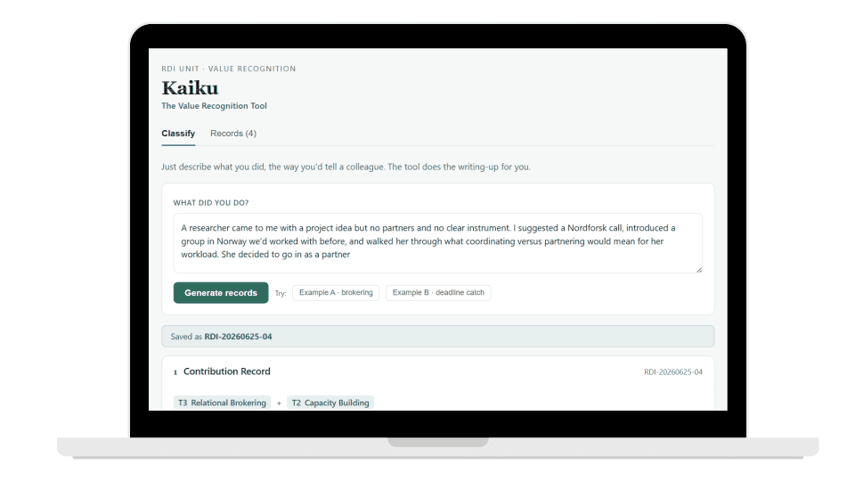
To demonstrate how the framework could operate in practice, I designed and prototyped an AI-supported value recognition tool that enables professionals to record their contributions through natural language while generating consistent organisational records and reusable knowledge.
To support adoption beyond the prototype, I also developed a Practitioner's Handbook to help the RDI unit and other institutions facing similar challenges replicate the inquiry process and apply the DIRECT Framework within their own contexts.
Outputs
Artefacts
Master's Thesis: "Service Ecosystem Design in Practice: Enabling Value Co-creation through Coordination in Shared Public Services. A Design-Led Study of Shared RDI Services in a University Consortium" - Grade: A (Excellent) - Link to Thesis| DIRECT Framework | AI Value Recognition Tool
Governance
Service Charter | Contribution Taxonomy
Communication
Board Presentation | Practitioner's Handbook
Impact & Reflection
Every inquiry produced tangible outcomes while leaving lessons that continue to shape how I work today.
Impact
AI-supported value recognition tool currently being piloted within the RDI unit.
DIRECT Framework and recommendations selected for presentation to institutional leadership.
Research findings informed ongoing discussions on service visibility, coordination, and governance.
Demonstrated a practical approach for capturing tacit support work using AI.
Reflection
This inquiry reinforced my belief that technology is rarely the starting point for organisational change. Before introducing new tools, organisations first need a shared understanding of the work they are trying to support.
AI became valuable not because it automated a task, but because it helped make complex human contributions easier to describe, recognise, and communicate.
Project


